
Responsible AI needs a foundation of trust
Can AI trust what it is making decisions on?
Artificial intelligence is moving rapidly from the digital world into the physical one.
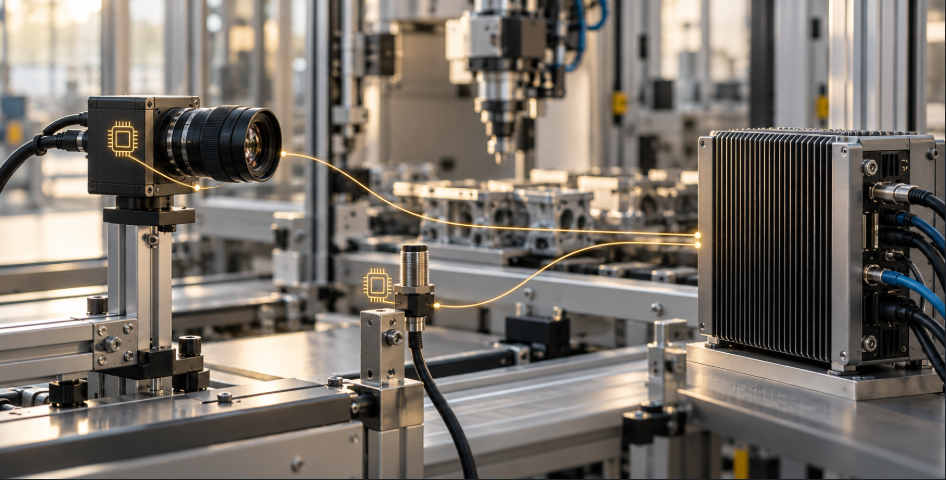
AI increasingly operates in cameras, machines, vehicles, industrial systems and critical infrastructure. Decisions that once required human interpretation can now be made locally by AI-enabled devices at the edge — in fractions of a second.
This creates enormous potential. It also changes the conversation about responsible AI.
Much of that conversation rightly focuses on algorithms, governance, transparency, human oversight and accountability. These are essential. Ultimately, responsibility for how AI is designed, deployed and used remains human.
But as AI becomes more autonomous and increasingly interacts with the physical world, there is another question we need to ask:
Can the AI trust the environment in which it operates?
Responsibility depends on trustworthy information
An AI system does not create its understanding of the physical world by itself.
It depends on information.
A camera provides an image. A sensor provides a measurement. A machine communicates its operating state. Another connected device provides a command or data point.
The AI model may process that information perfectly. But if the originating device has been compromised, substituted or manipulated, the system can still arrive at the wrong conclusion.
In other words, responsible decision-making does not begin with the algorithm alone. It begins with the integrity of what the algorithm is allowed to trust.
That requires us to look beyond the AI model and consider the complete environment around it:
- Is the device genuine?
- Can its identity be verified?
- Can the source of the data be trusted?
- Has the data been manipulated?
- Is the correct AI model running on an authorised device?
As AI becomes more autonomous, answering these questions becomes increasingly important.
Responsible AI must establish trust at machine speed
There is another dimension to this challenge: speed.
AI-enabled systems can increasingly interpret information and act without waiting for a person to validate every interaction.
That is part of their value.
In an industrial environment, a machine may need to react immediately to changing conditions. In critical infrastructure, connected systems continuously exchange operational information. At the edge, AI may process multiple data streams locally precisely because sending everything to a central environment would introduce latency.
Human responsibility remains essential. But humans cannot manually verify the identity and integrity of every device, data source or interaction before a machine acts.
Responsible AI therefore requires more than human oversight.
It also requires a technological architecture in which trust can be established at machine speed.
Trust starts with an authentic identity
Before a system can determine whether information from a connected device should be trusted, it needs to know which device it is communicating with.
That makes device identity an important part of the responsible-AI conversation.
When identity is rooted in hardware and remains bound to a device throughout its lifetime, it can provide a persistent foundation from which that device can be authenticated and its interactions controlled.
This creates a chain of trust:
Authentic identity → Trusted device → Trusted data source → More trustworthy AI decisions
It does not make an AI system ethical. Nor does it determine whether an AI decision is morally or legally correct.
Those responsibilities remain human.
But it gives the people designing, deploying and governing AI systems something fundamental: greater confidence in the technological environment on which those systems depend.
From responsible principles to responsible infrastructure
The responsible-AI debate is increasingly moving from principles towards practical implementation.
The Dutch government’s recent discussion of responsible military AI illustrates that shift: innovation and increasing autonomy need to coexist with human accountability, and those commanding AI-enabled systems need to be able to trust them and answer for their use.
That principle extends beyond defence.
As AI becomes embedded in the infrastructure, machines and devices around us, responsibility will increasingly depend not only on how models are governed, but also on whether the underlying technological environment can be trusted.
For those building the infrastructure around AI, that creates a responsibility of its own.
Identity, authenticity and integrity cannot be afterthoughts added once AI has been deployed. They need to be part of the foundation.
We believe trusted device identity is one element of that foundation. By establishing identity in hardware, connected devices can prove who they are throughout their operational lifetime — creating a stronger basis for authenticating devices, verifying data sources and controlling where AI models are allowed to operate.
Responsible AI cannot be achieved through cybersecurity alone. But trust in the technology it depends on must be part of the foundation.
Explore more insights

SandGrain and Axelera AI join forces to advance trusted AI at the edge
As artificial intelligence moves increasingly to the edge, trust becomes fundamental. It is no longer enough to know that an AI model can process data quickly and efficiently. Organisations also need confidence in where that data comes from, which devices can be trusted, and that the AI models themselves remain protected.

Leadership transition
As of September 1, 2026, Joeri Voets will step down as CEO and director of SandGrain. This decision follows discussions between the Shareholders, Supervisory Board and Executive Board regarding the company’s next phase of growth and the leadership experience required for that phase.

Agentic AI at the Edge: Why hardware-rooted trust is becoming essential
As organizations deploy Agentic AI, autonomous models that make decisions and trigger actions with minimal human oversight, the environments in which these agents operate become increasingly important.